


Download App
Whichever platform you use, we’ve got you covered.


Whichever platform you use, we’ve got you covered.

Modern stock analysis requires investors to sift through earnings transcripts, SEC filings, sentiment, technical indicators, institutional activity, and other market data. An AI stock analysis tool can process those inputs faster and surface patterns that would take an individual investor much longer to find.
Investors are increasingly turning to AI for that advantage. In fact, about 30% of U.S. retail investors said they were using AI tools to pick or alter investments in 2025, up 75% from the prior year. Research also suggests AI can compete with professional investors in some settings: a Stanford study found that an AI analyst outperformed 93% of mutual fund managers over a 30-year test period.
This guide compares the top AI stock analysis tools based on analytical depth, methodology, performance data, coverage, and accessibility so you can see which one fits your research process.
We reviewed each platform using its own published product and performance data, then cross-checked those claims against independent reviews where available. This gave us a clearer picture of how each tool works in practice, not just how the company describes it.
Every tool in this list was evaluated against the same five criteria:
The order below reflects the balance of all five, not just raw analytical horsepower, but power that everyday investors can actually access and apply.
AI stock analysis uses artificial intelligence to review financial and market data and help investors understand a stock more quickly. Depending on the tool, it may analyze company fundamentals, price trends, news, sentiment, earnings reports, or other data, then turn that information into scores, summaries, signals, or research insights.
FINRA notes that AI tools can analyze large sets of financial data and summarize complex documents, but investors should still verify the information before making decisions.
AI stock analysis and AI stock picking are often lumped together because both use AI to analyze market data. The key difference is how much of the research and investment selection process the tool handles for you. Here’s how they differ in terms of goal, output, investor involvement, and best use case.
The best AI investing tool depends on how you research stocks, the type of analysis you rely on, and how much of the research and decision-making process you want AI to handle. Some platforms focus on fundamental research, while others specialize in technical signals, sentiment, stock ratings, or automated insights. Here’s a breakdown of the best AI stock analysis tools and what each one does best.
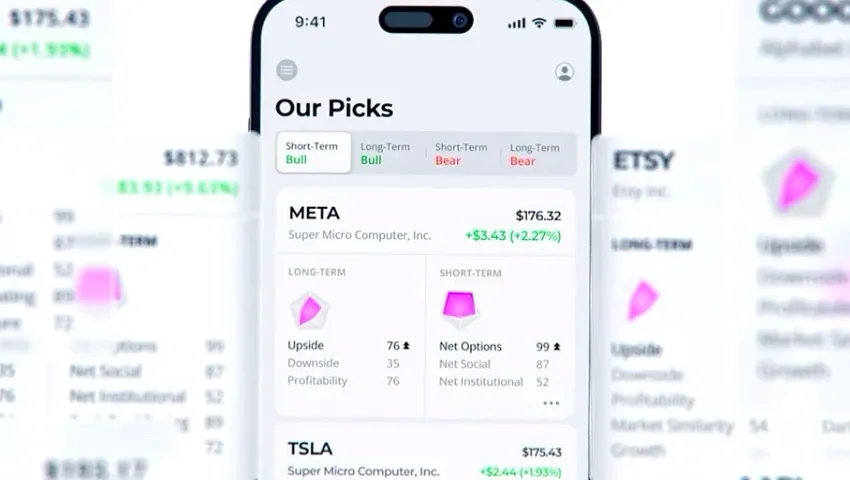
What it is: A free AI investing app that compresses millions of institutional data points into 10 plain-English signals, daily stock picks, and a daily stock analysis screener.
How its AI analyzes stocks: Prospero.ai uses a proprietary AI system developed through joint intellectual property with NYU. It analyzes institutional datasets such as order flow, market sentiment, trend strength, momentum, and short- and long-term positioning. The platform then distills that data into 10 signals that investors can compare and interpret.
Standout feature: The in-app learning guide. Most AI tools hand you a score and walk away. Prospero teaches you what each signal means and how to combine them, turning the app from a pick generator into a tool that builds durable investing skill.
Pricing: Free on iOS and Android. Premium tiers offer deeper screener capabilities and additional data feeds.
Best for: Self-directed investors who want institutional-grade stock analysis without a Bloomberg terminal or a $200/month subscription.
The verdict: Prospero.ai is the only tool delivering this combination of analytical depth, signal transparency, and zero-cost access. It has been featured in Forbes, Yahoo Finance, and VentureBeat, and was named one of the Top 5 AI Stock Picking Tools in an industry roundup. If you're looking for an AI stock analysis tool, Prospero.ai is a strong place to start.
Try Prospero.ai's free AI stock analysis tool.
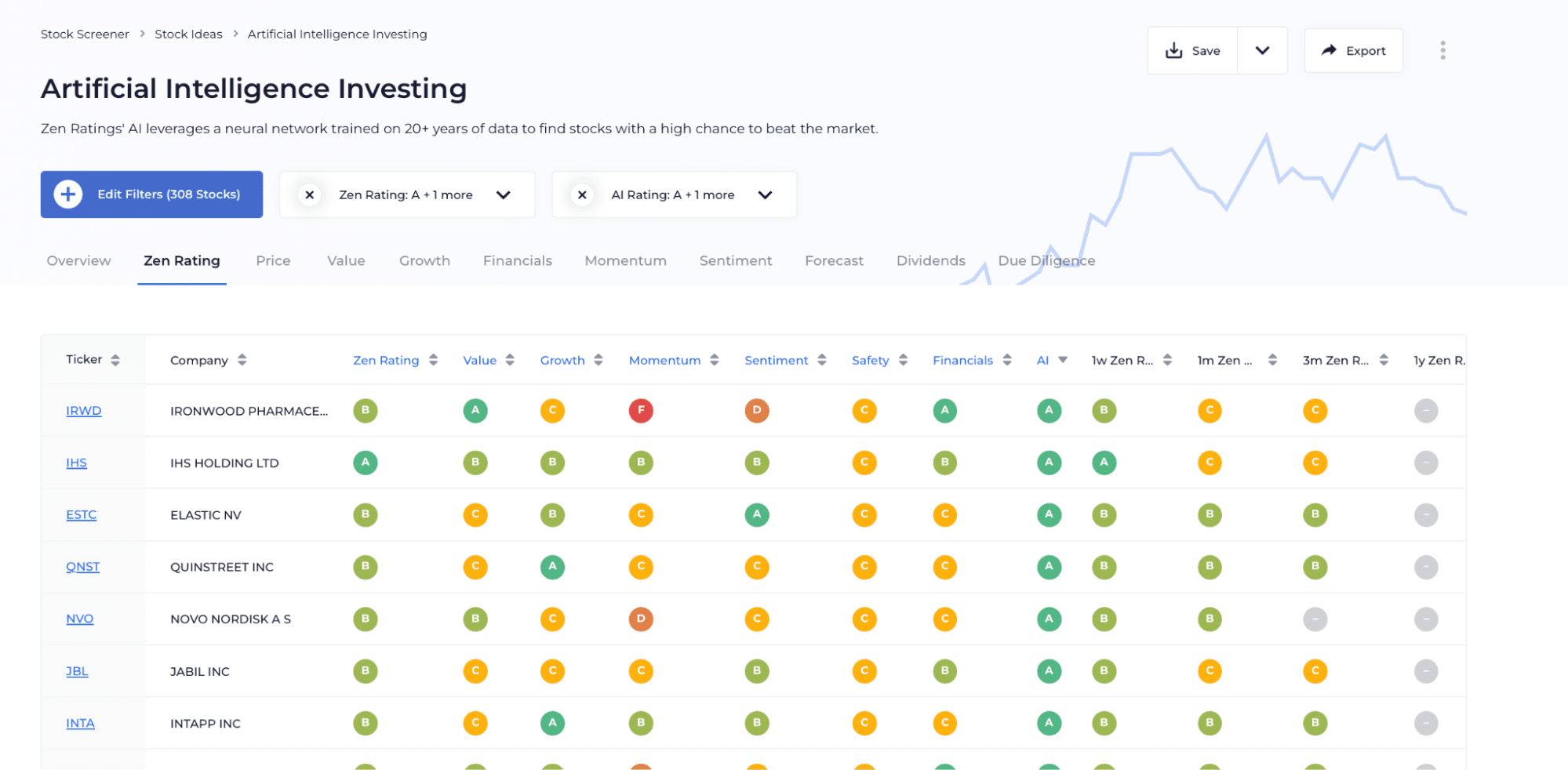
What it is: Zen Ratings is WallStreetZen’s stock rating system. It evaluates stocks across 115 factors and assigns an overall A-to-F grade, along with separate component grades for Value, Growth, Momentum, Sentiment, Safety, Financials, and Artificial Intelligence.
How its AI analyzes stocks: Zen Ratings includes a neural-network model trained on more than 20 years of fundamental and technical data. The AI factor looks for relationships across earnings, cash flow, price movement, industry trends, and other market inputs. Those results feed into the broader Zen Rating rather than replacing the other component grades.
Standout feature: Component Grade ratings. Investors can review the individual Value, Growth, Momentum, Sentiment, Safety, Financials, and AI grades rather than relying solely on the overall score.
Pricing: Free tier available; Premium is $19.50/month when billed annually, with a $1 trial.
Best for: Investors who want simple A-to-F grades backed by multi-factor analysis.
The verdict: WallStreetZen reports that stocks with an overall A Zen Rating have averaged 32.52% annual returns since 2003. That figure is based on the platform’s own historical performance data, so investors should treat it as past performance rather than a guarantee of future returns.
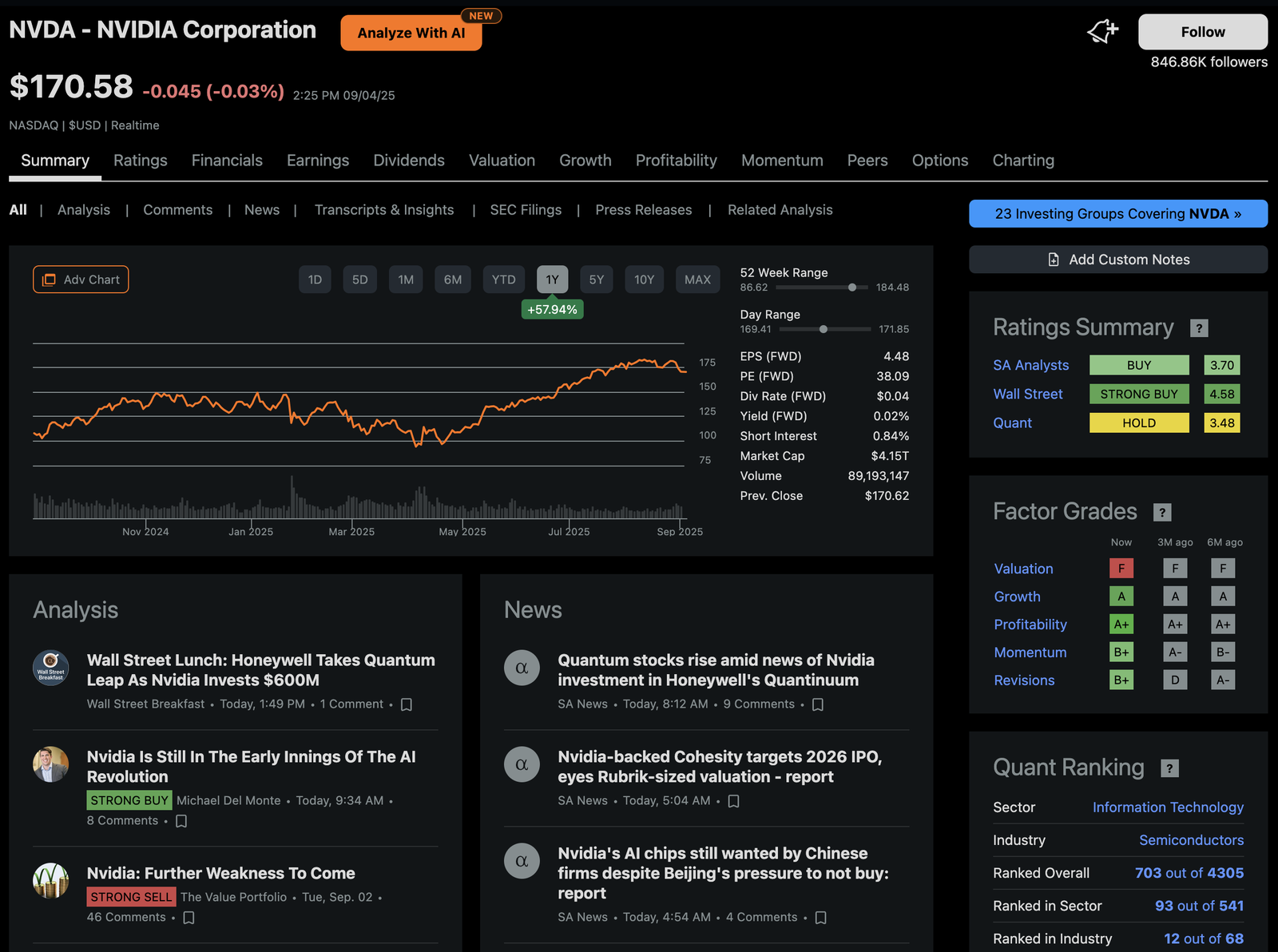
What it is: Seeking Alpha Premium is a fundamental research platform that combines Quant Ratings with AI-generated stock summaries. Its Quant Ratings grade stocks across Value, Growth, Profitability, Momentum, and EPS Revisions, while its Summary Reports pull together company information, ratings, analyst positives, and concerns.
How its AI analyzes stocks: Algorithmic analysis of 100+ fundamental and technical metrics per ticker. In 2026, Seeking Alpha added AI Virtual Analyst Reports that synthesize quant ratings, analyst opinions, and recent developments into coherent "should I own this?" summaries.
Standout feature: Virtual Analyst Reports. These AI-generated reports summarize a stock’s Quant Rating, company background, analyst positives, analyst concerns, and other information available on Seeking Alpha.
Pricing: Limited free access; Premium starts at ~$239/year.
Best for: Long-term fundamental investors who want quant discipline plus AI synthesis of qualitative research.
The verdict: Seeking Alpha stands out for investors focused on fundamental analysis. According to the platform, stocks with a "Strong Buy" rating have historically returned roughly 23.9% annually, compared with about 11% for the S&P 500.
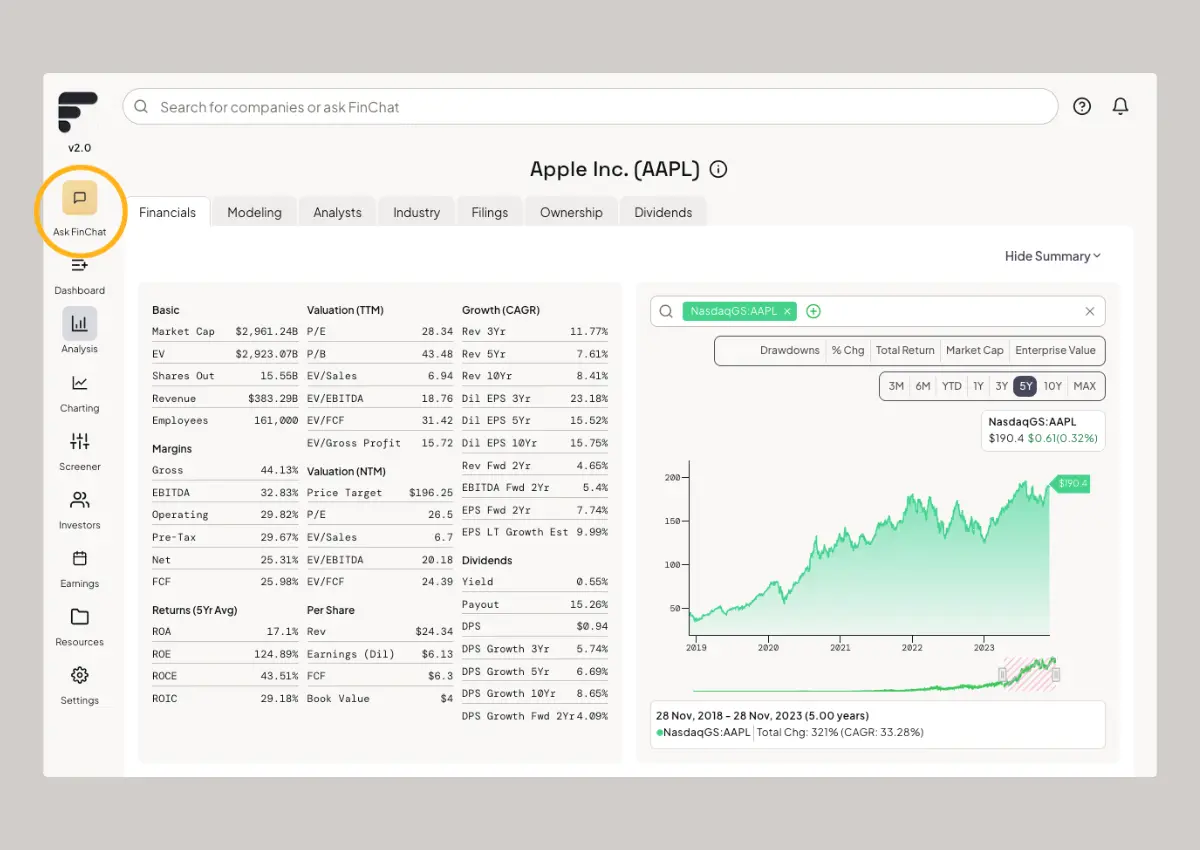
What it is: An AI-powered fundamental research terminal that lets you ask complex questions about any public company in plain English and get sourced, citation-backed answers.
How its AI analyzes stocks: Fiscal AI combines company financial data with a conversational AI layer. Its Copilot can analyze financial statements, ratios, earnings transcripts, analyst estimates, and other company data to answer research questions in plain English.
Standout feature: Copilot. Investors can ask company-specific questions in plain English and get answers based on Fiscal AI’s financial datasets, transcripts, and other research materials.
Pricing: Free tier; paid plans start around $20/month.
Best for: Fundamental investors who spend hours in earnings transcripts and 10-Ks and want AI to compress that work.
The verdict: FinChat is the closest thing retail has to a junior analyst on staff. For research-intensive investors, it's transformative.
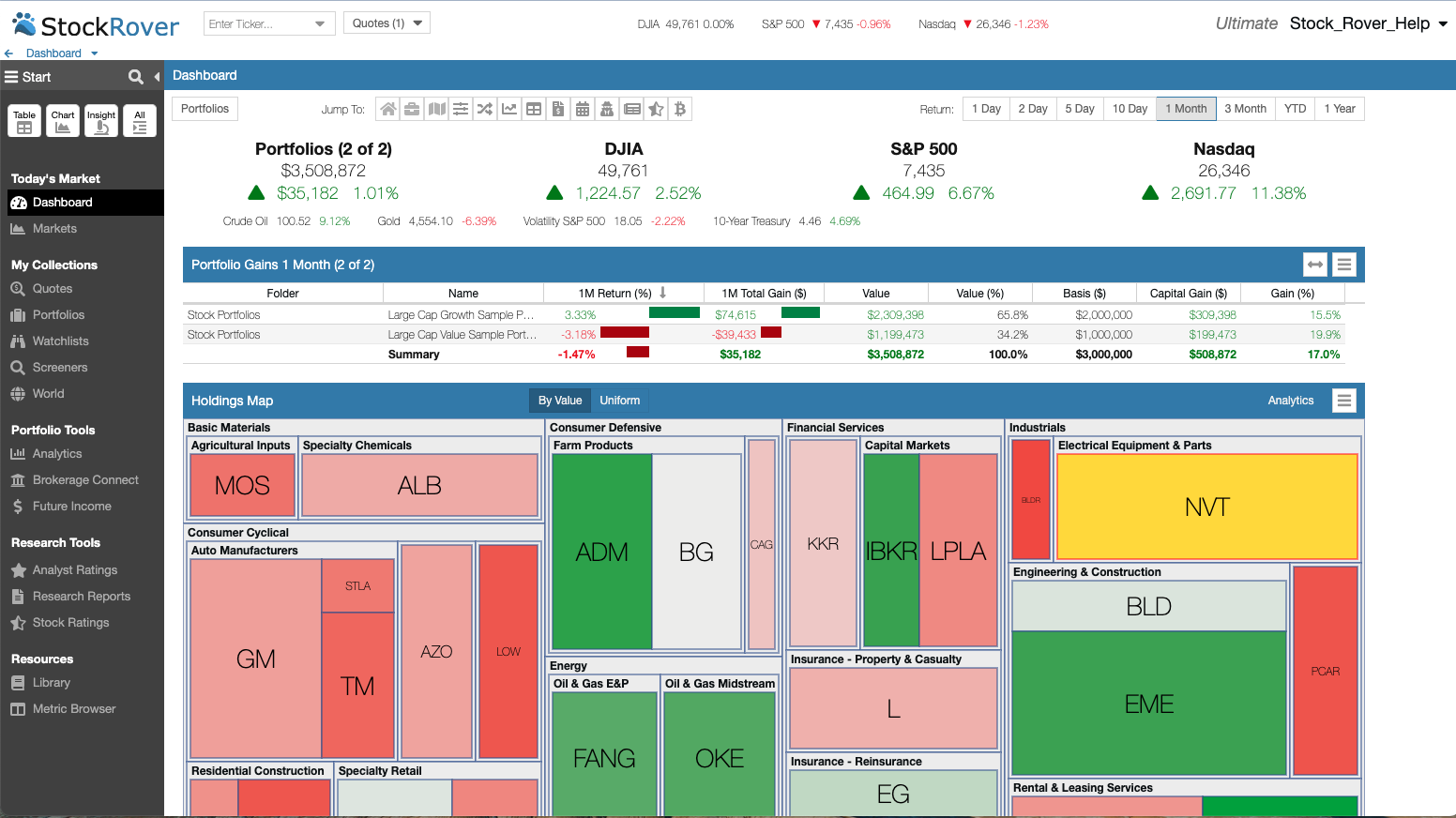
What it is: A research and screening platform with 650+ financial metrics, premium screeners, portfolio analytics, and research reports.
How its AI analyzes stocks: Combines comprehensive fundamental data with AI-assisted screening, ranking, and portfolio comparison tools. It is particularly strong for long-term value and dividend investors.
Standout feature: Stock Rover lets you compare any company against industry peers across hundreds of metrics with built-in analytical context.
Pricing: Free tier; Premium Plus is around $28/month, with an entry tier as low as $8/month.
Best for: Long-term, fundamentally-driven investors — especially value and dividend strategies.
The verdict: While Stock Rover offers fewer AI-driven features than some competitors, it delivers a good value for research and portfolio analysis. Investors looking for institutional-flow signals can pair it with Prospero.ai for additional market insights.
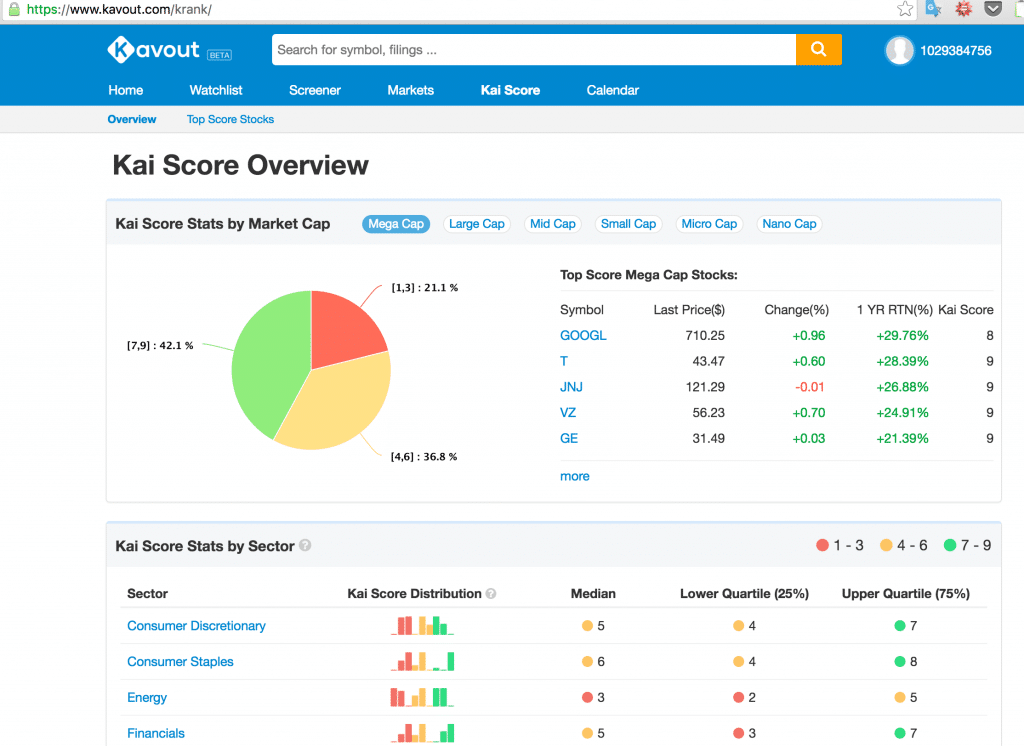
What it is: A quantitative AI platform built around the Kai Score, a 1–9 rating generated by deep learning on 9,000+ U.S. stocks daily.
How its AI analyzes stocks: Neural networks integrate 200+ factors spanning SEC filings, earnings, price momentum, institutional activity, and social sentiment.
Standout feature: Most Agreed Stocks view highlights stocks where Kavout’s Value, Momentum, and Quality models point in the same direction.
Pricing: Free tier with Kai Score access; paid plans start around $49/month.
Best for: Intermediate-to-advanced investors who want institutional-quality factor analysis.
The verdict: While there's a learning curve, Kavout's depth of analysis makes it a compelling choice for experienced investors seeking advanced research tools.
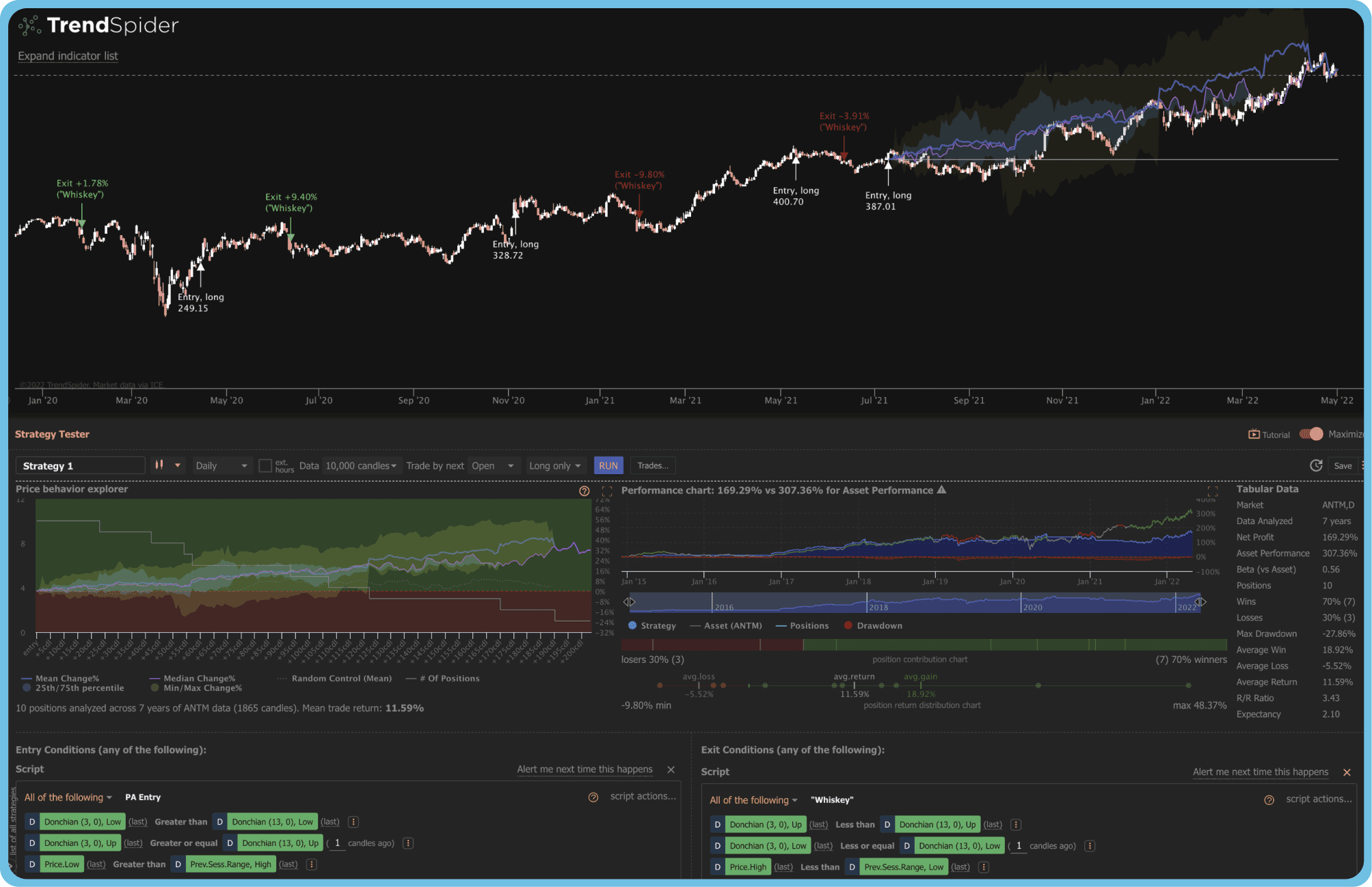
What it is: An AI-driven charting and technical analysis platform that automates the work chartists usually do by hand.
How its AI analyzes stocks: Automatically detects 220+ chart patterns and 150+ candlestick formations across multiple timeframes. The AI Strategy Lab lets you build and backtest rules-based strategies with no code.
Standout feature: Multi-timeframe analysis. TrendSpider can overlay and scan technical conditions across multiple timeframes, alongside its automated pattern-recognition tools.
Pricing: Plans range from roughly $33 to $156/month, with a 14-day free trial.
Best for: Chart-focused traders who want AI to handle pattern detection and backtesting.
The verdict: Rather than telling investors what to buy, TrendSpider focuses on automating the manual work involved in technical analysis. That makes it a strong choice for traders who rely on charts and technical indicators.
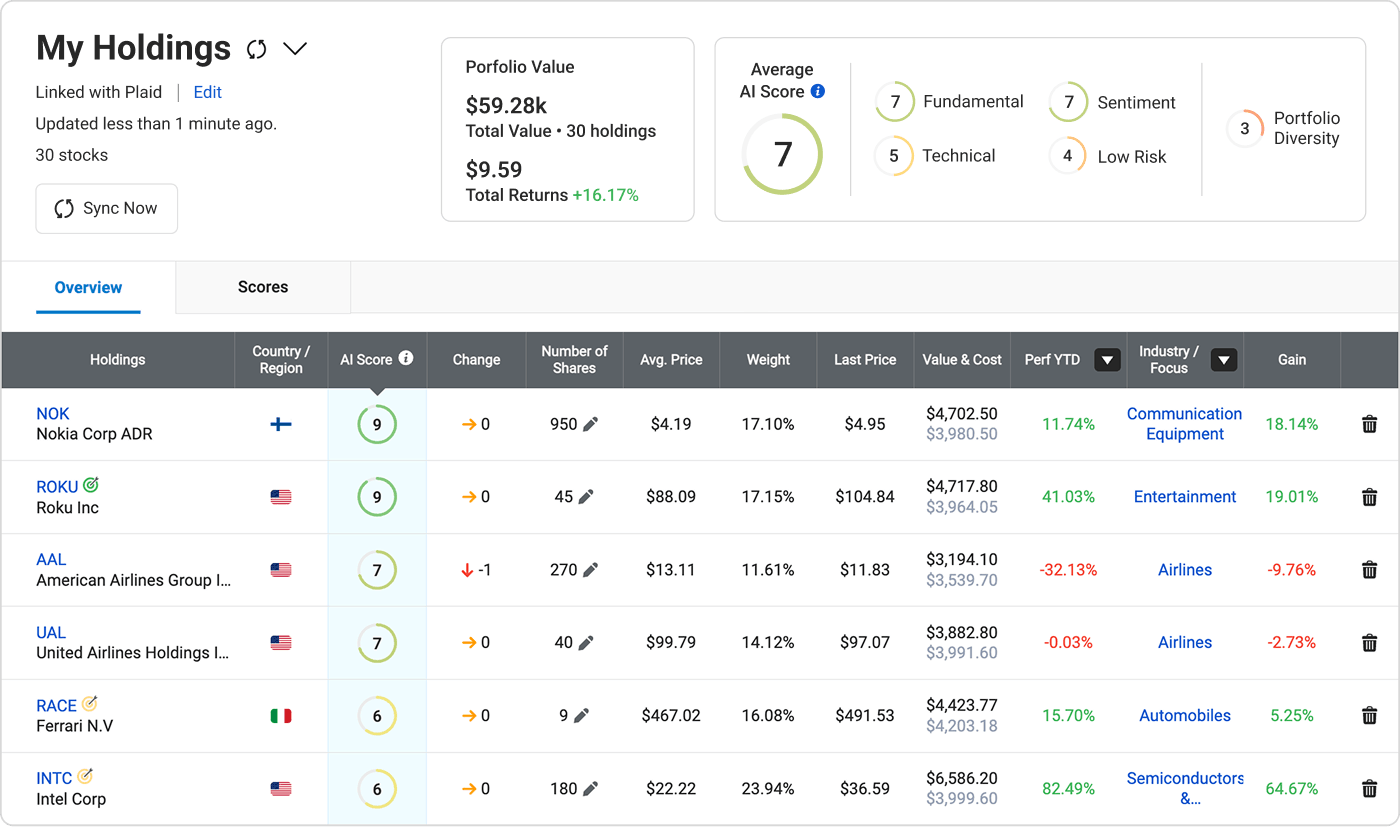
What it is: An AI-native analysis platform that assigns every stock an AI Score from 1 to 10, rating its probability of beating the S&P 500 over the next three months.
How its AI analyzes stocks: Processes more than 10,000 features per stock per day, drawn from 600+ technical, 150 fundamental, and 150 sentiment indicators. Machine learning models surface which specific alpha signals drove each score.
Standout feature: A "no black boxes" approach. Click any stock and see exactly which factors moved the score, like technicals, fundamentals, or sentiment.
Pricing: Free tier available; paid plans start around $23/month.
Best for: Investors who refuse to trust an AI score without understanding the reasoning behind it.
The verdict: Danelfin provides AI-driven stock ratings backed by publicly available historical performance data. According to the platform, its “Best Stocks” strategy returned 376% from January 2017 through mid-2025, compared with approximately 166% for the S&P 500.
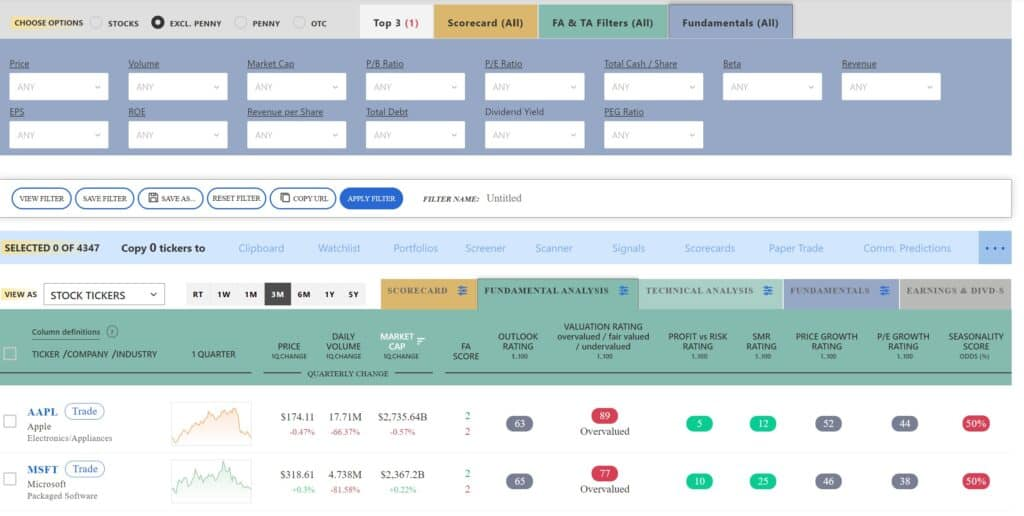
What it is: An AI-driven platform offering trading robots, real-time pattern recognition, stock forecasts, and screeners across stocks, ETFs, forex, and crypto.
How its AI analyzes stocks: Combines proprietary fundamental ratings with AI-detected technical patterns and forecast models. In 2026, Tickeron added Multi-Agent systems that combine multiple AI strategies into a single signal layer.
Standout feature: Real-time pattern recognition. Tickeron scans for technical formations and generates signals as those patterns develop across different timeframes.
Pricing: Free tier; paid plans typically range from $60–$250/month depending on features.
Best for: Swing traders and signal-driven investors who want pattern recognition baked into their analysis.
The verdict: Tickeron crams a lot into one platform. The learning curve is real, but if your edge depends on technical pattern timing, it earns its place.
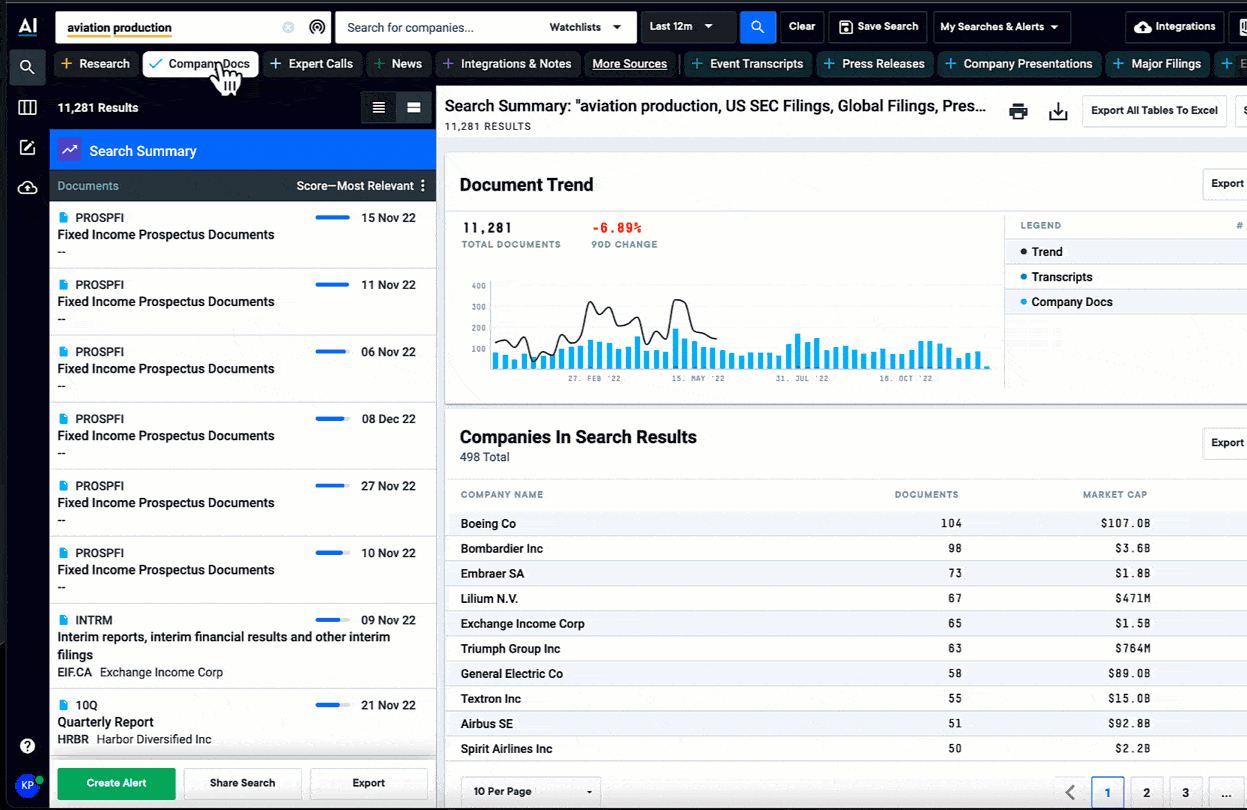
What it is: An AI-powered market intelligence platform used by the majority of S&P 500 companies and major hedge funds for qualitative research.
How its AI analyzes stocks: AI-powered search and synthesis across earnings call transcripts, broker research, expert network calls, SEC filings, and news. It surfaces themes, sentiment shifts, and competitive intelligence across thousands of documents instantly.
Standout feature: AlphaSense uses AI to summarize information across earnings calls, filings, research, news, and other documents, with tools for tracking recurring topics and themes.
Pricing: Enterprise pricing with a custom quote, generally out of reach for most retail investors.
Best for: Professional analysts, family offices, and serious self-directed investors who do deep qualitative research.
The verdict: AlphaSense is designed for research-intensive investing and offers a comprehensive set of market intelligence tools. Its higher price point may make it a better fit for professional investors and teams that need advanced research capabilities.
The right tool depends on where you need the most support in your investing process. Here’s how the options compare by use case.
If you already do deep fundamental research, you may want AI to speed up filings, transcripts, and company comparisons. If you prefer a more guided process, look for a tool that turns market data into clearer signals you can review quickly.
Prospero.ai is the best option for retail investors considering AI stock analysis tools that balance simplicity with deeper market insights. Its free app analyzes more than 100 million data points through 10,000+ AI and machine learning models, then turns that analysis into simpler signals, daily picks, and market insights without making the final investment decision for you.
Disclaimer: This article is for informational purposes only and does not constitute financial advice. Past performance is not indicative of future results. Always do your own research before making investment decisions.
Traditional stock analysis is largely manual. It can pull 10-Ks, read transcripts, build spreadsheets, and draw trendlines. AI stock analysis automates that work and adds pattern recognition across thousands of features simultaneously. The best AI tools also explain why a stock scored well, giving you both speed and reasoning.
Prospero.ai is the best free AI stock analysis tool in 2026. It delivers 10 proprietary signals, daily picks, and an in-app learning guide at zero cost on iOS and Android. Zen Ratings is a strong runner-up with free access to its 115-factor rating system on the web.
Some platforms have credible backtested track records. Danelfin's top-rated picks returned ~+376% from 2017 through mid-2025 vs. ~166% for the S&P 500, and a 2026 Stanford study found AI analysts outperformed 93% of mutual fund managers over 30 years. Backtests aren't guarantees, but the data suggests well-built AI tools can generate real alpha.
Yes, and in many ways, beginners benefit most. AI tools remove emotional bias, surface opportunities a novice would miss, and (in the case of Prospero.ai) explicitly teach the underlying concepts. Start with a free beginner-friendly tool before committing to paid platforms.
No. AI is a research accelerator, not a replacement for judgment. The best investors in 2026 are the ones who use AI to work faster and think more clearly, not the ones who outsource their decisions entirely. Verify the thesis, understand the company, and size positions appropriately.
Hedge funds use AI to scan large datasets, analyze filings and earnings transcripts, and identify patterns that may affect stock prices. They also use machine learning to forecast returns, manage risk, and adjust portfolio allocations. Human analysts still review the models because AI can misread data or perform differently as market conditions change.


Stay ahead. Daily updates with 27% better returns than S&P 500 with a 54% win rate vs. S&P 500 benchmarks on close to 5,000 picks since inception in 2023.*





%201.webp)
.webp)

.webp)