


Download App
Whichever platform you use, we’ve got you covered.


Whichever platform you use, we’ve got you covered.
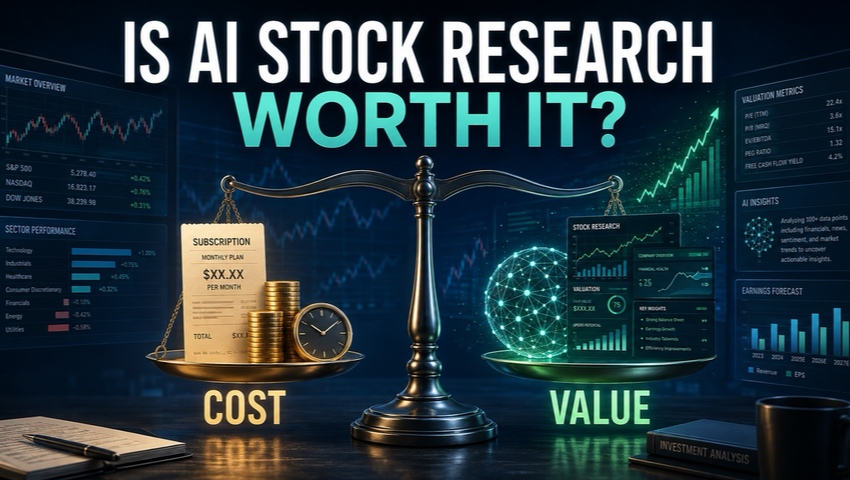
Short answer: For most individual investors, yes — but with a caveat. AI stock research is worth it when it saves you hours of manual work and surfaces signals you'd otherwise miss, and the cost floor has collapsed to between $0 and about $25/month. It stops being worth it the moment you use it to replace your own judgment instead of sharpening it. The real question isn't "is AI research worth the money?" — at today's prices, it's "am I using it the right way?"
The economics have shifted dramatically. Research capabilities that used to sit behind a $30,000-a-year institutional terminal now cost a few dollars a month, or nothing at all. Below is what you actually pay, what you actually get, and how to tell whether it's worth it for your situation.
Pricing spans an enormous range, and understanding the tiers is the whole game:
The headline: the gap between "free" and "genuinely capable" has never been smaller. For most retail investors, the meaningful decision happens entirely within the $0–25/month band.
The value of AI stock research isn't prediction — it's leverage. Here's where the return shows up:
For an investor whose time has any value, even a $25/month tool that saves a few hours a week clears its own cost easily. That's the core of the ROI case.
Being honest about this is what makes the answer trustworthy — and it's where a lot of buyers go wrong:
Worth it isn't a property of the tool. It's a property of how the tool meets your actual behavior.
Match the tool to how you actually invest, not to how impressive it sounds:
A practical test: if the tool changes what you do — the stocks you look at, the questions you ask, the mistakes you avoid — it's worth it. If it just gives you more to read, it isn't.
Here's the part that quietly resolves the whole "worth it?" debate: when the entry cost is zero, the ROI question mostly disappears. You can get institutional-grade signals without betting a subscription fee on whether you'll use them.
That's the model behind Prospero.ai — free mobile access to AI-driven stock analysis, layering a proprietary AI factor on top of value, growth, sentiment, and momentum signals across thousands of stocks, with built-in education so you understand why a stock scores the way it does. The point isn't to hand you picks. It's to compress the research layer to seconds and keep you in the decision seat — at a price that makes "is it worth it?" almost moot.
Adoption reflects exactly this shift. By 2026, U.S. retail AI-investing adoption had reached roughly 62%, driven mostly by the fact that tools once locked behind an institutional desk now cost a few dollars a month — or nothing.
Is AI stock research worth it? For nearly every individual investor, yes — because the cost has fallen to near zero while the time savings and signal access are real and measurable. The catch is entirely about usage: treat AI as a research engine and it's one of the best deals in investing; treat it as a decision-maker and no price is low enough. Start free, use it to think faster rather than think less, and let the value prove itself before you pay for more.
Is AI stock research worth paying for? For most active investors, yes — but you rarely need to start by paying. Free and sub-$25/month tools deliver institutional-grade signals and save hours of manual research. Paid tiers are worth it once you're consistently using features the free tier doesn't offer.
How much does AI stock research cost? It ranges from free to enterprise-grade. Entry-level paid tools run about $16–25/month, low-cost annual plans land around $79–239/year, and a serious individual research stack runs roughly $700–800/year. Institutional platforms cost $1,000+/month.
Can free AI stock research tools actually compete with paid ones? For many investors, yes. Free tiers now offer AI stock scores, screening, and analysis that would have required an expensive terminal a few years ago. The main limits are usage caps, narrower coverage, and fewer advanced features.
Does AI stock research actually improve returns? Indirectly. AI doesn't guarantee better returns, but it saves time, applies consistent criteria, and surfaces information you might miss — which can lead to better-informed decisions. The edge comes from combining AI research with human judgment.
Is AI stock research worth it for beginners? Yes, especially free tools with built-in education. Beginners benefit most from AI that explains why a stock scores a certain way, helping them learn faster while avoiding the cost of a subscription they may not fully use yet.


Stay ahead. Daily updates with 27% better returns than S&P 500 with a 54% win rate vs. S&P 500 benchmarks on close to 5,000 picks since inception in 2023.*




%201.webp)
.webp)

.webp)