


Download App
Whichever platform you use, we’ve got you covered.


Whichever platform you use, we’ve got you covered.
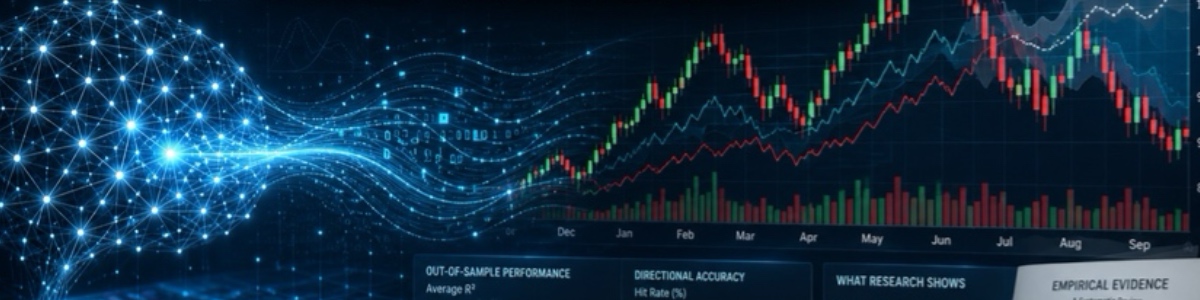
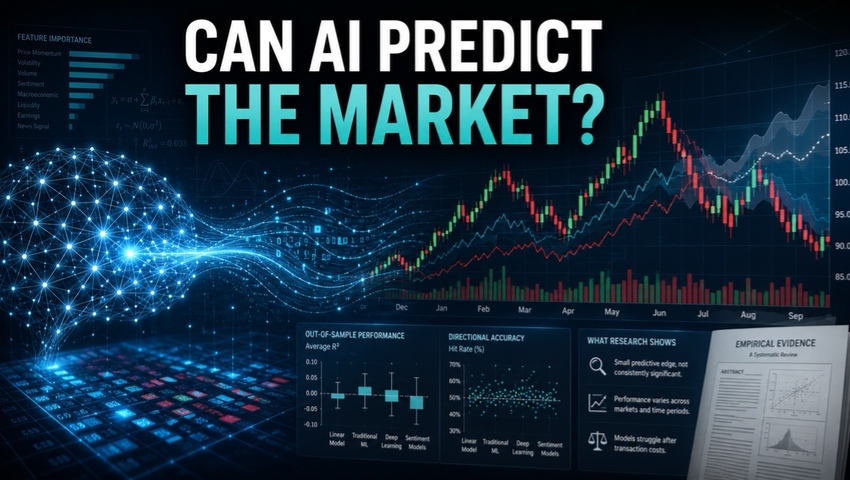
Short answer: Partly. AI can predict the short-term direction of a stock with modest, statistically meaningful accuracy — research puts next-day directional calls in the range of 54–58%. But it cannot reliably predict exact prices, it can't time crashes, and its edge shrinks quickly beyond a week or two. AI is best understood as a research accelerator, not a crystal ball.
That's the honest, evidence-based answer — and it sits between two exaggerations you'll hear everywhere: that "AI has solved the market" and that "AI is useless because markets are random." Neither is true. Below is what the research actually shows, where AI genuinely helps, and where it reliably fails.
Before judging whether AI can predict stocks, it helps to separate three very different claims people lump together:
AI is meaningfully good at the first and progressively worse at the second and third. A model can be directionally right and still lose money if it misses the size of the move, the timing, or the volatility around it. Directional accuracy is seductive, but on its own it isn't the same thing as a tradable edge.
This distinction matters because most "AI predicts the market" headlines quietly rely on directional accuracy — the easiest of the three — while implying something closer to precise price forecasting, which no model has cracked.
Across academic reviews and industry backtests, a consistent picture emerges:
The through-line: AI delivers a modest, real, short-lived edge — not certainty.
AI's biggest wins in investing aren't about fortune-telling. They're about processing scale and speed that no human can match:
In all of these, AI doesn't need to "predict" perfectly. It compresses the research layer — the slow, manual work of finding what's worth a human's attention — into something close to real time.
Understanding the failure modes is what separates investors who use AI well from those who over-trust it:
None of these are temporary bugs to be engineered away. They're structural limits of predicting a complex, adaptive, human-driven system.
The most effective approach in 2026 isn't to hand decisions to a model — it's to split the work into two layers:
Let AI own the research layer. Use it to screen the market, surface unusual activity, summarize documents, measure sentiment, and backtest ideas. This is where AI's speed and scale create a genuine, repeatable advantage.
Keep humans on the strategic layer. What the business actually does, whether management can execute, competitive dynamics, macro context, and geopolitical or regulatory shifts with no clean historical analogue — these require forward-looking judgment that historical data can't supply.
And set your parameters before you act: decide what accuracy threshold makes a signal worth acting on, what position size fits that confidence level, and what conditions would make you exit. AI narrows the information gap; you still make the call.
This is exactly the philosophy behind Prospero.ai — using AI to do the heavy research lifting (scanning, scoring, and surfacing signals across the market) while keeping you, the investor, in the decision seat. The goal isn't to predict the future. It's to help you see more, faster, and decide better.
Can AI predict the stock market? It can tilt the odds — modestly, and mostly in the short term. It can't foresee crashes, guarantee outcomes, or replace judgment. Treated as a decision-maker, AI will eventually burn you on the event it never trained for. Treated as a research engine that reduces the information gap, it's one of the most powerful tools an individual investor has ever had access to.
Use it for what it's good at. Stay human for the rest.
Can AI predict stock prices accurately? Not exact prices. AI can predict short-term direction with modest accuracy (roughly 54–58% next-day in research settings), but it cannot reliably forecast exact price levels, magnitude, or timing — and its accuracy fades quickly beyond about 5–10 trading days.
Can AI predict a stock market crash? No. Crashes like March 2020, the 2023 SVB failure, and the January 2026 CPI shock were outside historical training data, and no machine-learning model reliably predicted their timing. AI struggles most precisely when markets behave abnormally.
Is AI better than humans at investing? AI is better at scale and speed — screening, summarizing, and pattern detection. Humans remain better at strategic judgment, interpreting novel events, and understanding business fundamentals. The strongest results come from combining the two.
What is AI actually good at in the stock market? Screening thousands of securities, detecting unusual activity, summarizing earnings and filings, measuring sentiment, flagging risk, and backtesting strategies — the research layer of investing, done in seconds.
Does AI give investors a real edge? A modest one. Research shows AI can add a few percentage points of directional accuracy, which can be meaningful with proper risk management — but that edge is small, short-lived, and erodes as more traders adopt similar models.


Stay ahead. Daily updates with 27% better returns than S&P 500 with a 54% win rate vs. S&P 500 benchmarks on close to 5,000 picks since inception in 2023.*



%201.webp)
.webp)

.webp)