Download App
Whichever platform you use, we’ve got you covered.


Whichever platform you use, we’ve got you covered.

The votes are in, and investors are already reassessing the winners and losers.
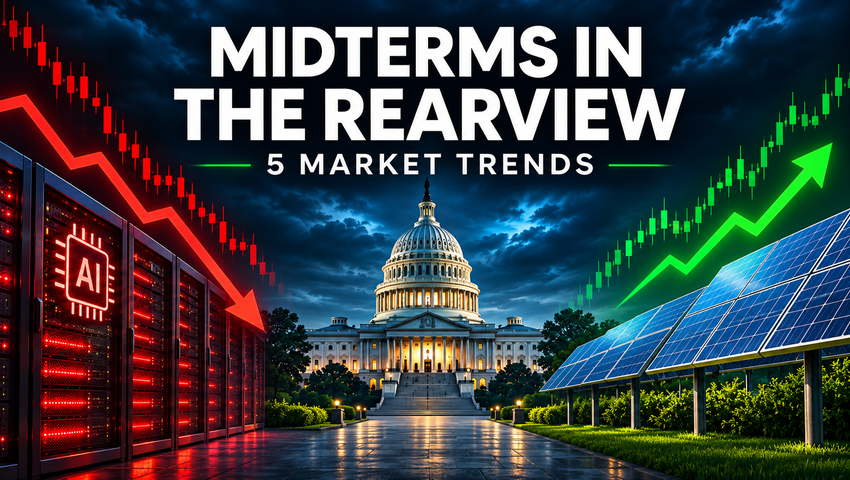
Democrats’ victories in the House and Senate set the stage for divided government. Solar and healthcare stocks rallied, while Musk-linked businesses and parts of the AI trade faced selling pressure. The broader market’s initial rebound masked some sharp differences beneath the surface.
Here are five themes from the first trading session after the midterms and the questions that will determine whether they last.
Market moves below are November 4, 2026 premarket or intraday snapshots, as identified. They are not closing returns and were recorded at different times.
CoreWeave (CRWV) fell 6.6% and Oracle (ORCL) lost 4% in Schwab’s opening report. Investors were weighing greater scrutiny of data-center development, including potential restrictions in Texas.
Yet later Reuters reporting showed Microsoft, Amazon, and Alphabet rising while data-center operators declined. Calling this an across-the-board AI selloff would miss the distinction.
Our interpretation: investors are becoming more selective about which businesses can turn AI demand into attractive returns. For a company financing new capacity, construction delays can change the economics. An established cloud platform may face a different balance of risks and opportunities.
The question to watch is whether permitting, financing, or operating costs actually change. A political headline can move a share price immediately; the effect on a company’s profits takes longer to establish.
Tesla (TSLA) and SpaceX (SPCX) fell more than 5% and 6%, respectively, in Schwab’s opening report, with investors concerned about possible congressional investigations following Elon Musk’s support for Republicans.
The investment question is how much that scrutiny could affect business outcomes. Hearings, regulatory decisions, and government relationships can matter, but they do not all carry the same financial consequences.
Investors should watch for specific developments that change costs, contracts, approvals, or demand. The first day’s reaction tells us that political exposure is being repriced. It does not yet establish the size of any earnings impact.
First Solar (FSLR) gained 9.4%, Sunrun (RUN) rose 10%, and Enphase Energy (ENPH) advanced 7.6% in Reuters’ initial premarket report. Investors anticipated a more supportive policy environment for clean energy.
That gives the sector a fresh catalyst, but solar companies have different business models. Manufacturers, residential installers, and equipment suppliers will not necessarily benefit equally from the same policy.
The next step is to connect the optimism to business results: orders, financing availability, customer demand, and margins. A strong sector rally can lift many names together before investors begin separating the likely beneficiaries.
Medicaid-focused insurers and hospital operators also rallied. Reuters reported Centene (CNC) up more than 8%, Molina Healthcare (MOH) around 6% higher, and hospital operators gaining between 6% and 8% in early trading.
The policy hopes included extending enhanced Affordable Care Act subsidies and delaying provisions expected to reduce Medicaid enrollment or constrain payments. Analysts also cautioned that presidential veto power could limit major legislative changes.
For investors, this makes the details essential. An insurer’s exposure to government programs differs from a hospital’s exposure to reimbursement and uninsured patients. The useful question is which policy changes could meaningfully alter each company’s earnings outlook.
Northrop Grumman (NOC) fell about 5%, while RTX (RTX), Lockheed Martin (LMT), and L3Harris (LHX) each lost more than 3% in Reuters’ initial premarket report. Investors questioned the path for Trump’s proposed defense spending.
Our reading: the risk is a gap between spending expectations and what Congress ultimately approves. A company can continue winning contracts while its stock falls if investors had priced in faster growth.
Watch appropriations, contract awards, and management guidance. Those developments will help show whether the reaction reflects a temporary reset in expectations or a material change in future revenue.
These moves offer an early map of investors’ expectations. Turning that map into an investment thesis requires checking the link between policy and company profits.
For each business, ask what changed, how it could affect revenue or costs, and how much of that change the share price already reflects. Keep earnings, valuation, and financing needs in the analysis alongside politics.
The midterms are in the rearview. The next test is whether the new expectations show up in business results.
For informational purposes only. Not investment advice.


Stay ahead. Daily updates with 27% better returns than S&P 500 with a 54% win rate vs. S&P 500 benchmarks on close to 5,000 picks since inception in 2023.*